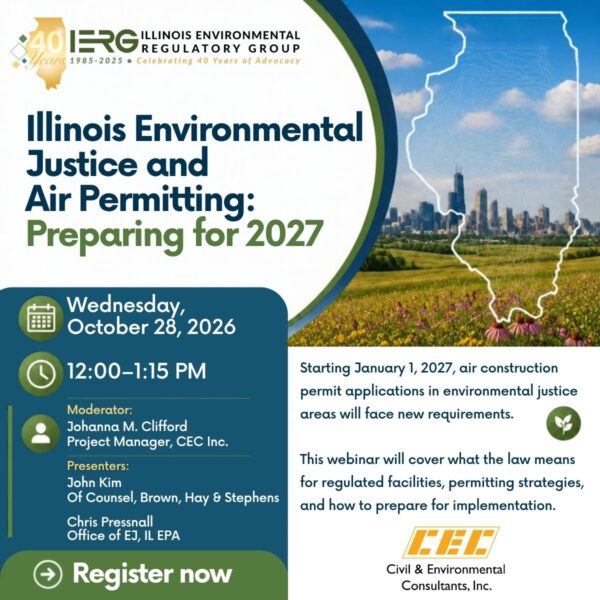
Gov. Pritzker has signed Senate Bill (SB) 3772, introducing environmental justice (EJ) into Illinois’ air permitting program, starting January 1, 2027. Although the Illinois Environmental Protection Agency (IEPA) has not yet published specific guidance or implementation procedures, organizations can look to states that have already incorporated environmental justice into their air permitting programs for practical lessons.
Project developers will need to understand not only traditional permitting requirements but also how EJ considerations may influence project review and stakeholder engagement strategies. Engaging internal teams and consultants to monitor, proactively assemble relevant community and environmental data, review internal compliance records, and consider early outreach to potentially impacted communities can help streamline future permitting.
Different States, Different Approaches
Based on CEC’s experience supporting environmental permitting projects nationwide, several common themes have emerged: earlier screening, broader evaluation of existing community conditions, increased public participation, greater attention to mitigation, and integrating EJ considerations into project planning.
New Jersey is particularly useful because it now has several years of implementation experience. Its program requires identification of environmental and public health stressors, an Environmental Justice Impact Statement, public participation, and an agency decision.
New York’s Department of Environmental Conservation mandates an assessment of disproportionate burdens on disadvantaged communities, requiring permit reviews to consider existing environmental burdens, cumulative impacts, and co-pollutant effects. Massachusetts has adopted a comprehensive approach by requiring additional community outreach and cumulative impact evaluation for certain projects in EJ communities, aiming to ensure new permits do not worsen existing disparities. Connecticut also integrates EJ considerations into its permitting by requiring enhanced public engagement and review of potential impacts on overburdened communities. These examples illustrate strategies states use to better protect vulnerable communities and increase transparency throughout the permitting process.
Consideration of applicant compliance history during permit review is not unique to Illinois. Illinois and California both have statutory provisions authorizing permitting agencies to evaluate an applicant’s compliance record as part of a permit review. Although Minnesota has proposed a similar compliance-history-related component within its cumulative impacts framework, the proposed provisions have not yet been finalized. Importantly, SB 3772 did not create a new compliance history review authority in Illinois. Instead, it requires the IEPA to perform and publicly document a compliance history review that the Agency was already authorized to conduct under Section 39(a).
You may hear SB 3772 described as Illinois’ cumulative impacts law. While that’s a useful description of the concept behind the legislation, the statute does not establish or define cumulative impacts analysis or methodology. Instead, it directs IEPA to consider a broader set of existing environmental burdens, community vulnerabilities, and project-specific impacts as part of its review of covered construction permits.
Lessons Emerging from Other States
Lesson One: Start Early
One of the most consistent lessons is that EJ considerations are best addressed early in project planning, not in the final stages of permit application development. EJ isn’t just an environmental compliance issue; it’s a project development and scheduling issue.
Early screening can help identify whether a project may be located within or near an EJ community, what existing environmental burdens may be present, and whether additional analyses could be beneficial before permitting begins.
Project teams should consider potential EJ requirements when developing permitting schedules, construction timelines, and internal decision points.
Don’t wait until the permit application is nearly complete to discover that EJ requirements apply.
Examples:
In Colorado, applicants for new or modified permit applications must submit an Environmental Justice Summary before filing their air permit application.
New Jersey updated its EJMAP stressor data in 2026 and requires applications submitted after March 31, 2026, to use the updated dataset. (Department of Environmental Protection).
Lesson Two: Understand & Engage with the Community
EJ reviews often extend beyond facility boundaries. Community engagement is becoming part of permitting strategy. Proactively addressing questions and communicating transparently can build trust, educate the public, and streamline future permitting.
Understanding local demographics, existing industrial operations, nearby sensitive receptors, community priorities, and historical environmental concerns provides project teams with strategic, valuable information. Understanding the community can help project teams anticipate potential questions from regulators and stakeholders and actively engage the community to increase environmental awareness.
Once community engagement becomes part of a formal permitting process, it needs to be planned like any other project milestone.
Lesson Three: Evaluate Compliance History
SB 3772 requires consideration of an applicant’s environmental compliance record during application review. Similar trends have emerged in other jurisdictions, where agencies increasingly view historical compliance performance as relevant when evaluating future operations.
Facilities with strong environmental management systems and well-documented compliance programs that demonstrate operational stewardship during permitting can streamline the review, public comment period, and approval process.
A facility’s compliance history can play an important role in how regulators evaluate future permit applications.
Lesson Four: Plan for Additional Analyses
Depending on project type and location, permit applicants may be asked to provide supplemental air quality modeling, additional emissions evaluations, or other technical assessments to help regulators better understand potential impacts on surrounding communities.
Building flexibility into project schedules can help minimize unexpected delays.
Lesson Five: Build the Right Project Team
Successful projects typically involve multidisciplinary teams that combine permitting, engineering, environmental, and community engagement experience. The right project team must successfully manage:
- Technical evaluations,
- Emissions analyses,
- Air quality dispersion modeling,
- Environmental justice screening,
- Public outreach support, and
- Strategic permitting guidance.
Team members who have worked in states with established EJ programs can identify potential challenges early and develop approaches that align with evolving regulatory expectations.
Just as importantly, project teams should include individuals who can communicate technical information to a variety of audiences. Community members, local officials, regulators, and project stakeholders often have very different perspectives and information needs. Clearly explaining project impacts, answering questions, and facilitating productive dialogue can help build trust throughout the permitting process.
Project teams must address public health concerns to increase environmental awareness and trust with the community.
Looking Ahead
Understanding how other states have implemented EJ requirements provides valuable insight into what Illinois project developers may encounter in the future. But an equally important question remains: How did Illinois get here?
Over the past decade, Illinois has taken several steps toward formalizing its approach to EJ. Significant agreements, such as the Informal Resolution Agreement between the IEPA and the U.S. EPA, also played a central role in shaping the state’s EJ priorities and framework. These efforts laid out the groundwork for comprehensive legislation like SB 3772, reflecting both community concerns and federal guidance on equity in environmental decision-making.
In the next article, we’ll examine the events that helped shape Illinois’ EJ framework, including the EJ concerns raised in the state, the Informal Resolution Agreement between IEPA and U.S. EPA, and how those discussions ultimately contributed to the development of SB 3772. We’ll also explore perspectives from former IEPA Director John J. Kim on the evolution of EJ policy and what project developers should understand moving forward.
About This Series
This article is the second in CEC’s Environmental Justice and Air Permitting Series. CEC has been following the EJ rulemaking process in the state of Illinois and throughout the country, and our team is continuing to assist clients in navigating the ever-changing regulatory landscape. If you have any questions regarding environmental justice and how your projects may be impacted, please contact our experts:

Carla Adduci | Principal
cadduci@cecinc.com, 267.568.2300

Leah Blinn | Corporate Air Quality Practice Lead
lblinn@cecinc.com, 412.249.1607

Johanna Clifford | Project Manager III
jclifford@cecinc.com, 630.949.2749

Post a Comment