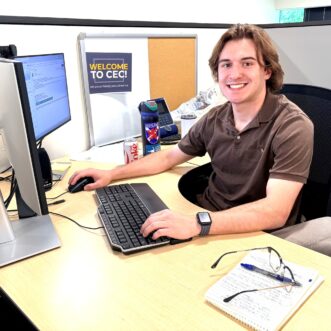
 My name is Reilly Burke, and I’m a rising junior at the University of Illinois at Urbana-Champaign studying civil engineering. Over the past school year, I became increasingly interested in pursuing an opportunity that would allow me to explore professional career paths in my major. This summer, I’ve had the opportunity to intern with the solid waste practice at CEC’s Monroeville office, where I gained valuable insight into the worlds of landfill design and solid waste management all while living in a new city.
What drew you to an internship with CEC’s Solid Waste Management team, and how did the experience meet or exceed your expectations?
Solid waste management stands out as a unique industry out among the many career paths that studying civil engineering can lead to. I was drawn to the opportunity to learn about a niche practice that effects everyone while gaining experience with a national company that has a foot in the door in markets across the United States. It seemed like the ideal way to introduce myself to the industry.
I did not know what to expect, going into an industry I knew little about. The experience gave me a deeper understanding of the crucial industry that is solid waste management, and the structure of consulting firms. It also helped me recognize the professional skills important for engineers to develop. I was trusted with meaningful responsibilities and contributed to projects that had real impact. By supporting my team members in this work, I gained a clearer understanding of the future responsibilities I will take on as a practicing engineer.
What were some of the most valuable technical, professional, or field skills you developed during your internship?
As a first-time intern, there were many engineering skills I developed this summer. I was able to enhance my Excel knowledge. It is a tool that I was familiar with but had not realized the prominence of in the engineering environment. I was also introduced to engineering specific software like Bluebeam Revu, Civil3D, and Slide2 – tools that I haven’t often seen in education. I also bolstered my ability to read drawings and engineering documents, and I gained a better understanding of engineering standards and project organization. In addition, working alongside experienced co-workers and mentors and participating in meetings strengthened my ability to communicate ideas clearly. Overall, I was able to fill in soft-skill and technical gaps in my progression towards becoming an engineer by interning here at CEC.
What opportunities did you have to experience various aspects of solid waste management, such as fieldwork, permitting, compliance, design, or data analysis?
The opportunities I had during this internship tied into various aspects of solid waste management. For example, I gained exposure to permitting and compliance by drafting sections of an Environmental Assessment and for Soil Erosion and Sedimentation Control forms for a municipal waste landfill, during which I learned what environmental considerations occur during the siting and design of a landfill. On the data analysis side, I reviewed groundwater statistics, landfill gas well liquid elevations, traffic counts, and other data and prepared summaries and estimates for various projects. The design work I was given included slope stability calculations as well as erosion and sediment control design. Several projects tied into multiple of these aspects, so I got a taste of many different sides of solid waste management work.
How did this internship help you better understand the environmental consulting and solid waste management industry?
Coming into this internship, I had little knowledge about what differentiates a consulting engineering firm or the challenges that come with operating a landfill. These past two months with CEC have given me a clear picture of how consulting firms help waste management clients keep their projects operating safely and compliant with regulations and environmental protections. Everyone knows that landfills exist, but few are aware of the processes that keep them running. I better understand the range of problems that can arise in waste disposal; including groundwater contamination, slope stability, elevated temperatures, and landfill gas; and how firms like CEC help clients prevent and mitigate these issues.
Can you share an example of a challenge you encountered and what you learned from overcoming it?
The biggest challenge I faced was the general hesitation of trying to solve problems day one. As an intern with minimal experience in the solid waste management industry, it seemed like diving headfirst into the unknown. I solved this problem by simply asking for help from my co-workers. Many of them were in the same shoes early in their career and understand this is a learning experience! All of them were willing to explain the projects and guide me in the right direction, and I noticed the importance of the willingness to learn and collaborate in the workplace.
Why would you recommend CEC to other college students who are interested in environmental consulting or solid waste management careers?
CEC was a great place to spend a summer furthering my professional development. Interning can sound intimidating, but my peers at CEC have been nothing but supportive during my time here. My team members have always been willing to carve out time to educate me on solid waste management practices and landfill operations, show me their work, and assign me tasks to assist them. Working for CEC gave me the opportunity to contribute to a wide range of projects while gaining exposure to many different areas of the solid waste management industry.
If you had to describe your CEC internship experience in three words, what would they be and why?
First, I’d say it was educational. I learned firsthand about consulting and waste management, topics I was not very familiar with when I started. I gained extensive insight into how environmental regulations shape projects and how safety precautions are built into landfill design. My peers were always willing to mentor me and share their experiences. Next, I’d describe it as challenging. As this was my first experience in the industry, I had a lot to learn. However, that required me to ask questions and think proactively about the tasks I’ve been assigned. I’d also call it rewarding. I’ve developed technical skills by being exposed to engineering software, calculations, and drawings in a work setting. Also, I’m more confident in my ability to communicate in a professional setting after this internship.

Post a Comment