Owner/Client
West Virginia Department of Environmental Protection, Abandoned Mine Lands
West Virginia Department of Environmental Protection Agency
Location
Harrison County, WV
CEC Services
- Erosion & Sedimentation Control/NPDES Permitting
- Site Grading/Earthwork Analysis
- Site Infrastructure Maintenance/Rehabilitation
- Wetland AMD Treatment
- Wetlands & Waters Delineations
- Detailed Design
- Hydrogeologic Site Investigations
- Stormwater Piping and Culvert Inspections
- LiDAR Surveys – Short and Long Range

Owner Objective
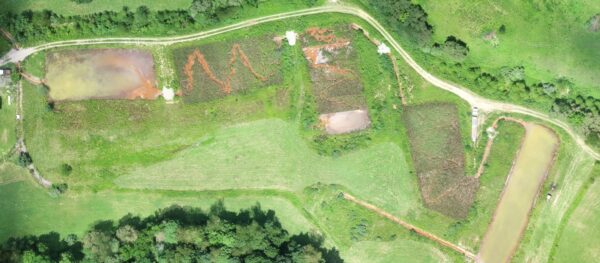
This project was on the site of a relic Acid Mine Discharge (AMD) remediation project previously designed and constructed in the 1990’s. This passive AMD treatment project was originally constructed to mitigate AMD coming from the old Francis Mine which was previously abandoned, resulting in unstable coal refuse, erodible soils with poor vegetation, and problematic mine drainage from acid-producing materials. The passive treatment facility was coming to the end of its useful service life and required significant maintenance to continue use. Additionally, a change in land ownership resulted in the new property owner expressing a desire to completely remove the large facility and repurpose the land for agricultural purposes. The West Virginia department of Environmental Protection, Abandoned Mine Lands (WVDEP-AML) saw an opportunity to redesign the existing AMD treatment facility using modern day analysis and design techniques to significantly reduce footprint of the passive treatment facility while maintaining a satisfactory level of AMD treatment efficacy above that of the existing site.
CEC Approach
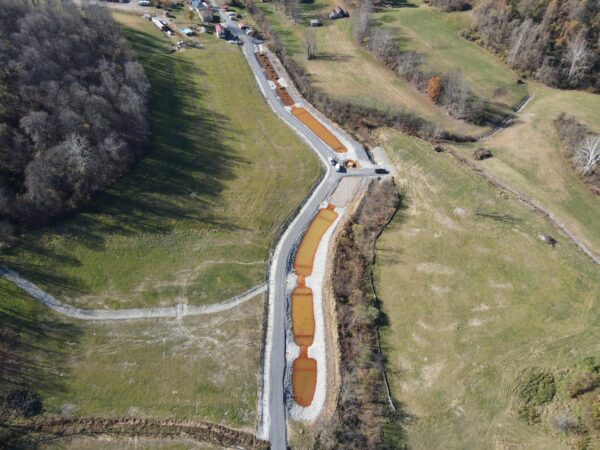
CEC was contracted by the WVDEP-AML to evaluate the existing treatment facility and make recommendations for re-design while reducing the overall treatment footprint. CEC performed a forensic evaluation of the historic data provided by the WVDEP-AML to determine the in-situ treatment efficacy of the system to be re-designed. CEC’s geochemists also performed field testing to validate the findings from the historical data. Armed with this baseline data, CEC prepared several rounds of conceptual designs informed by the treatment parameters to provide to both the WVDEP-AML and the landowner for consideration. The final design was composed of a series of stepped, long, and narrow treatment cells consisting of oxidation beds, polishing wetlands, and a flushable limestone bed. A Fluid Dynamics siphon encased in a concrete vault was utilized to provide a completely passive and automated flushing limestone bed component to the system. The proposed treatment facility was designed against the side of the landowner’s property to maximize the space available for livestock grazing. A construction sequencing plan was prepared that allowed the contractor to divert the constant inflow of AMD around the site while construction on the proposed system was taking place. A demolition plan was developed that allowed that provided detail as to how to decommission the existing treatment system during construction of the new system. CEC also provided a balanced site in such a manner that the contractor could utilize multiple sources of borrow material depending on the WVDEP-AML’s and Landowners desires during construction. The design intent would result in a site footprint reduced by approximately 85% while still providing similar levels of treatment.
CEC delivered preliminary design plans complete with survey and subsurface investigation under an accelerated timeline of 60 days from receiving Notice to Proceed. The construction was completed in Fall of 2024. Post-construction treatment efficacy in the reduced footprint system showed much better results than anticipated, resulting in a successful project for the WVDEP-AML.