CEC assists oil and gas operators with the implementation of air permitting and compliance programs in response to federal, state, and local regulations. We provide services to upstream and midstream facilities throughout the Utica and Marcellus regions, and general air quality consulting expertise nationwide.
CEC’s oil and gas air services team, centered in Pittsburgh, PA, offers tailored expertise to clients. This regional team of permitting and compliance professionals can readily mobilize to solve your most pressing permit application, regulatory compliance, modeling evaluation, and field measurement challenges.
Permit Applications
CEC helps clients implement timely and effective air permitting strategies. Through active participation with the regional oil and gas trade associations and ongoing professional development, CEC stays abreast of local, state, and federal permitting changes. We work closely with air permitting personnel at the state and local levels and have developed long-term relationships that enable us to better serve clients. Whether it’s a new GP-5A in PA, the electronic G70-D in WV, one of the many General Permits available from OEPA, or a major project subject to PSD or NNSR, CEC has experience. In fact, CEC has advocated on behalf of the industry through the public comment process and will continue to do so as regulations evolve.
Regulatory Compliance
Once facilities have been installed and are operating, CEC can help with ongoing compliance obligations. CEC inspects installations for conformance with permit application specifications, creates compliance calendars to help define the universe of operating permit recordkeeping and reporting obligations, and conducts third-party compliance audits to ascertain if compliance gaps exist. Among many other types of compliance-related services, CEC helps clients report under 40 CFR 98, Subpart W for GHG emissions, develop annual emission inventories, dissect complex regulations such as NSPS OOOO and OOOOa to help clients understand their obligations, and prepare state-specific compliance demonstration reports.
Modeling Evaluations
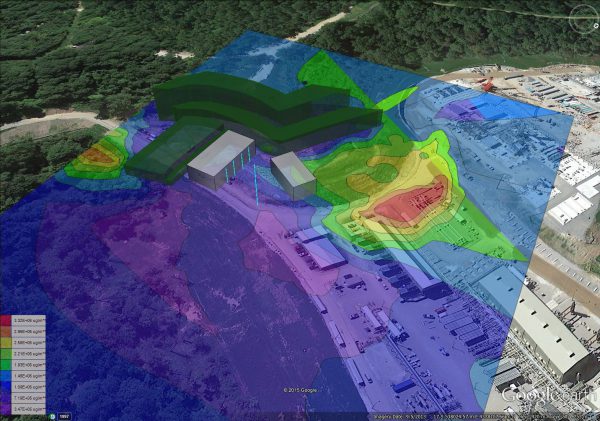 CEC employs a team of air dispersion modeling scientists and engineers who use the latest versions of EPA-approved software such as AERMOD to perform required air impacts analyses. From screening-level air toxics evaluations to the refined modeling required for a PSD application, CEC has the trained personnel, skills, and resources to develop and negotiate modeling protocols, refine modeling inputs through an iterative process, and prepare written modeling reports.
In addition to dispersion modeling tools, CEC uses specialized models such as ProMax®, E&P Tanks, and GRI-GLYCalc to characterize emissions from process operations. Our engineers can specify the appropriate extended analyses for input to these emission estimation procedures and help to determine if facility designs will conform to specified permitting requirements. If enhanced emission controls are required, CEC can assist with the evaluation of RACT/BACT/LAER or other control technology options, as appropriate.
Field Measurements
 CEC can address fugitive component LDAR needs as well. Through traditional walking surveys or in combination with our small unmanned aerial systems (sUAS) team, we complete NSPS OOOOa or state-specific fugitive leak surveys and work with clients to document that leaks have been fixed.
CEC also has developed and implemented long-term perimeter ambient air quality monitoring programs to characterize VOC emissions from shale gas surface impoundments and other area sources. Through upwind and downwind deployments of SUMMA® canisters or other time-integrated sampling systems, CEC collects data and evaluates source-specific contributions. In combination with portable meteorological monitoring instruments, we can help to evaluate odor complaints as well as possible mitigation measures.