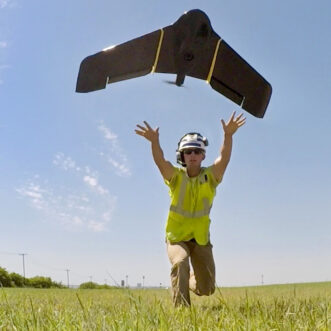
CEC provides turnkey services to address landslide-related issues. Our geotechnical engineers provide initial assessments, perform investigations, and develop remedial designs. Our construction services professionals manage repairs and provide construction quality assurance during repairs by others.
Landslides are an ongoing problem for many roadways, both privately owned and under state or county jurisdiction. In addition, landslides can happen along pipeline rights-of-way and earthen embankments. CEC provides recommendations to address landslides and helps companies select the best solution for remediation.
Landslide Assessments
CEC geotechnical engineers perform assessments of landslides at facilities or along rights-of-way to assess the severity of the landslide and provide recommendations to address the ground movement.
Geotechnical Investigations
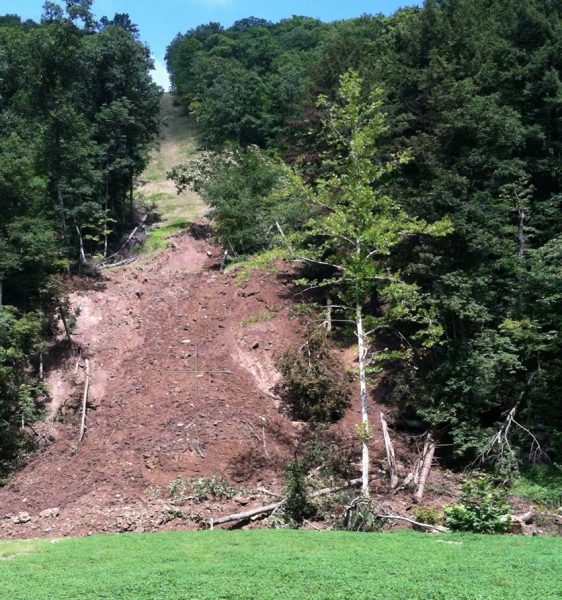 Significant landslides require a subsurface investigation to assess the severity of the landslide and rate of movement, as well as to design a repair. Regulatory agencies often require subsurface investigations as well. Depending on the conditions, CEC’s geotechnical investigations can include:
- Test drilling with split-spoon, Shelby tube, or rock sampling
- Excavating test pits with bulk soil sampling
- Hand sampling of soils using bucket augers or other methods
- Installing slope inclinometers
- Laboratory testing
Remedial Designs
During the design phase of a project, CEC will perform the following services to aid in determination of the appropriate remediation solution:
- Geotechnical desktop survey
- Site reconnaissance
- Preparation of bid, permitting, and/or construction documents
CEC’s geotechnical engineers analyze the data gathered and develop cost-effective remedial designs using current software and analytical methods for slope stability analyses, retaining wall designs, and stabilization techniques.
Pile and lagging wall design or plug wall design – CEC will utilize PYWALL or LPILE software for analyzing piles under lateral loading using the p-y method to provide a suitable pile size and spacing. CEC can also provide pile analyses when appropriate utilizing GRLWEAP, which predicts driving stresses and estimates driving time.
Soil nail wall design (with or without steel mesh) – CEC will utilize Snailz for soil nail slope analyses to provide the appropriate number of rows as well as soil nail depth and spacing.
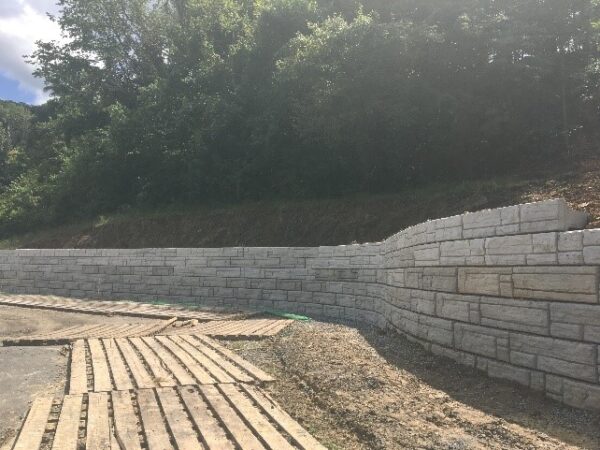
Gravity retaining walls (recon block, bin block, or gabion baskets) – CEC will utilize manufacturer software, Excel spreadsheets, or hand calculations to finalize the design of a gravity retaining wall.
Alternative methods such as regrading or flattening slopes, geogrid-reinforced buttresses, or cement-stabilized soils – CEC will utilize these methods either separately or in conjunction with other methods dependent upon site conditions.
Construction-Phase Services
CEC construction services professionals can manage the remedial construction, manage subcontractors, or provide support during bidding and construction as needed. Additionally, CEC’s construction inspectors are experienced in performing field testing and monitoring for compliance with the design plans and specifications. CEC can also provide design-build services on selected projects.
Additional Services
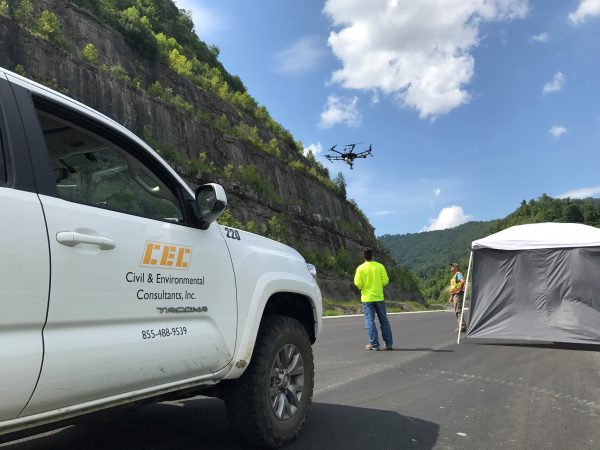
CEC performs other services often needed to complete the remedial design of a landslide or to facilitate the repair. Surveying the limits of the landslide, access, and surrounding property/topography is typically needed to complete the design and to prepare the construction documents for remediation. CEC utilizes a number of different survey technologies including total station, 3D LiDAR scanning, and unmanned aerial vehicles (UAVs or drones) depending on the site conditions. In addition, CEC performs wetland and stream delineations and completes erosion and sediment control permitting, which are often necessary to remediate landslides. CEC has also designed and completed stream restoration to address impacts associated with landslides.
Emergency/High-Hazard Inspections
CEC has an in-house pilot and is permitted by the FAA to operate its own UAVs. The quad-copter or fixed-winged UAVs can be rapidly deployed to obtain video footage, photography, and/or topographic information in emergency situations, high-hazard areas, or where there is unsafe terrain.