CEC Ecological Sciences botanical team, led by Kyle Filicky, PWS, CERP, discovered two new Pennsylvania element occurrences of mountain bellwort (Uvularia puberula) and St. Andrew’s cross (Hypericum stragulum).
The Pennsylvania Department of Natural Resources and Conservation (PA-DCNR), Pennsylvania Natural Heritage Program (PNHP) and NatureServe assign both mountain bellwort and St. Andrew’s cross as Vulnerable (State Rank 3). These species are classified as vulnerable due to limited potential suitable habitat within southwestern Pennsylvania and ranges within 21 to 100 occurrences.
CEC botanists identified approximately 2,344 mountain bellwort and 36 St. Andrew’s cross individuals within the 47-acre project area. Due to the proposed project activities, CEC proposed to relocate approximately 1,115 mountain bellwort and 36 St. Andrew’s cross individuals. PA-DCNR approved the proposal to relocate the plants to suitable habitat areas where the permitee will continue monitoring these plants for the next five years.
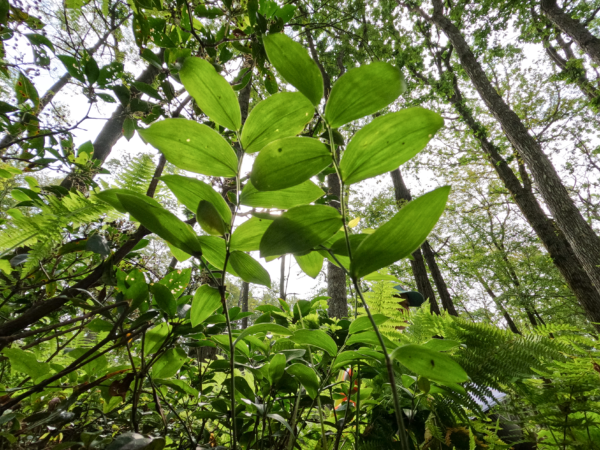
What is mountain bellwort (Uvularia puberula)?
In Pennsylvania, there are four species in the genus Uvularia and include:
- Uvularia grandiflora – large-flowered bellwort
- Uvularia perfoliate – perfoliate bellwort
- Uvularia puberula – mountain bellwort
- Uvularia sessilifolia – sessile-leaf bellwort
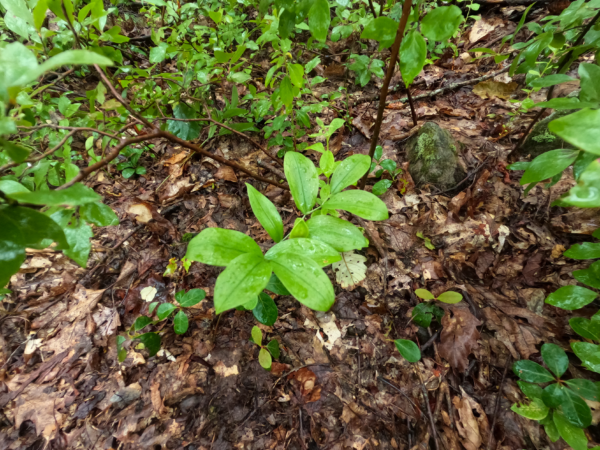
Each of these species are perennial and emerge in the spring within rich, shaded, woodland habitats. However, mountain bellwort can be distinguished from the other three by the following key identification characteristics (mountain bellwort (Uvularia puberula):
- Stout underground rhizome with clustered, elongated, thickened roots. These roots spread horizontally from the base of the plant to form new individuals, allowing for the
establishment of large colonies. - In the late summer to early fall, a triangular, football-shaped, seed capsule that can be green in color can be observed.
- A single zig-zagged stem that supports alternating broad, rounded, leaves. A mature, or reproductive individual, produces a forked upper stem. The upper portion of the stem is puberulent, or hairy.
-
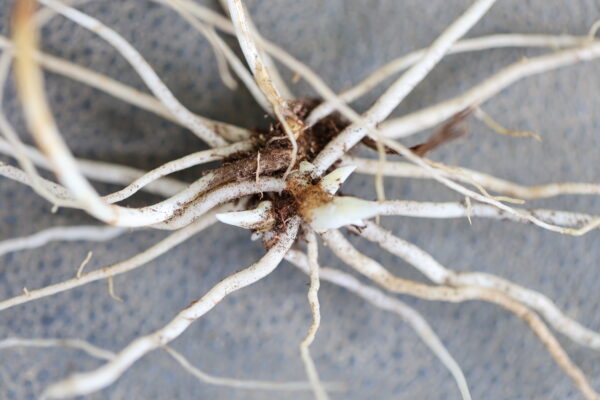
Mountain bellwort stout rhizome, with clustered, elongated, thickened roots. 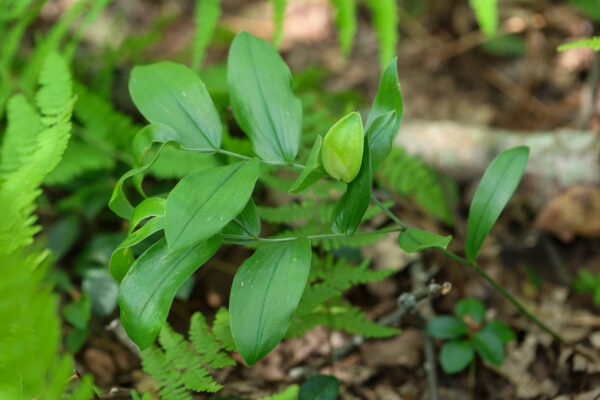
Mountain bellwort triangular shaped seed capsule. 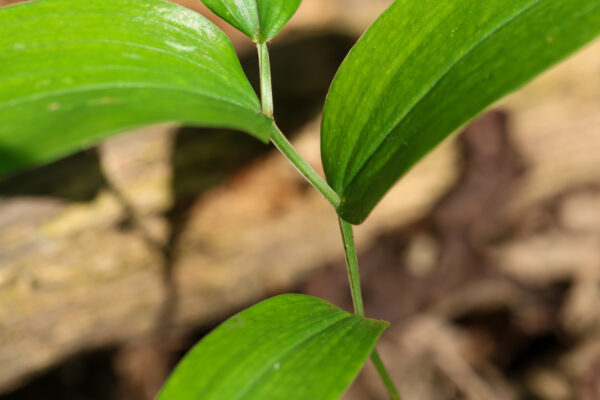
Mountain bellwort puberulent, zig-zagged, upper stem.
Within the United States, this species is typically found throughout south-central Appalachia ranging from northern New York to as far south as Georgia and Alabama. Within Pennsylvania, mountain bellwort is limited geographically to the southwestern region where suitable habitat for this species is present.
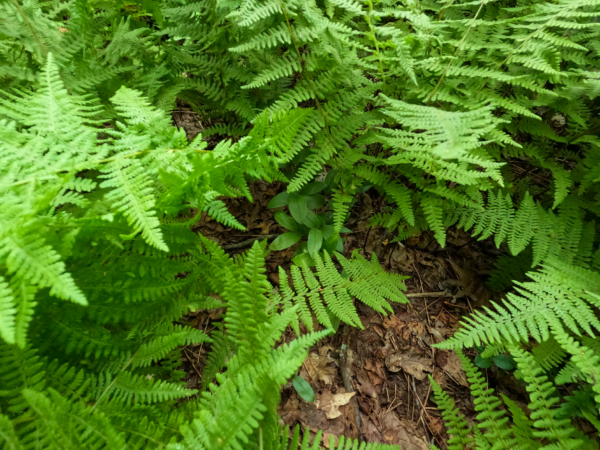
Throughout the proposed project area, mountain bellwort individuals were observed and documented from open areas, where individuals were easy to see versus highly competitive areas, where it was difficult to find underneath existing vegetation.
What is St. Andrew’s cross (Hypericum stragulum)?
In Pennsylvania, there are 18 species in the genus Hypericum and include:
- Hypericum adpressum – bog St. John’s-wort
- Hypericum bartramium – American great St. John’s-wort
- Hypericum boreale – dwarf St. John’s-wort
- Hypericum canadense – Canada St. John’s-wort
- Hypericum crux-andreae – St. Peter’s-wort
- Hypericum densiflorum – mountain bushy St. John’s-wort
- Hypericum denticulatum – strict St. John’s-wort
- Hypericum drummondii – Drummond’s St. John’s-wort
- Hypericum ellipticum – pale St. John’s-wort
- Hypericum gentianoides – pineweed St. John’s-wort
- Hypericum gymnanthum – clasping-leaf St. John’s-wort
- Hypericum majus – great Canada St. John’s-wort
- Hypericum mutilum – common dwarf St. John’s-wort
- Hypericum perforatum – European St. John’s-wort
- Hypericum prolificum – shrubby St. John’s-wort
- Hypericum punctatum – spotted St. John’s-wort
- Hypericum sphaerocarpum – barrens St. John’s-wort
- Hypericum stragulum – St. Andrew’s cross
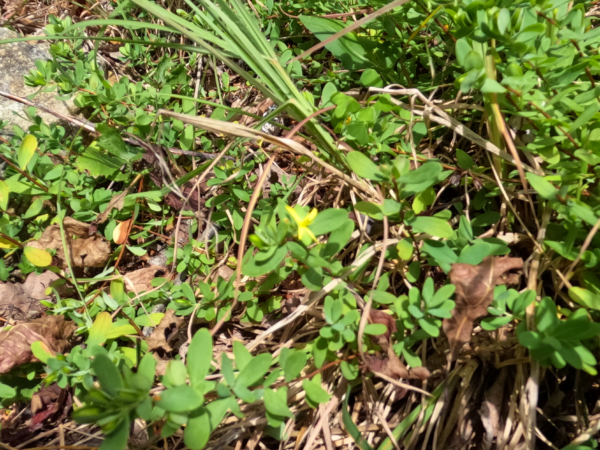
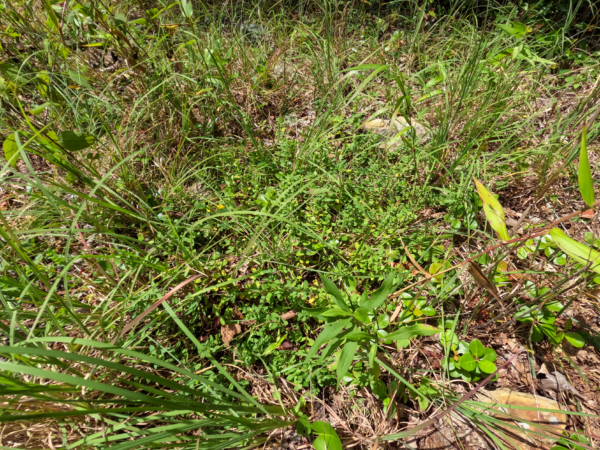
St. Andrew’s cross is a perennial, low-growing, shrub that prefers xeric (dry) open habitats such as grasslands, successional clearings, open woods, and barrens. This species can be distinguished by the other 17 species by the following characteristics (Hypericum stragulum; St. Andrew’s cross):
- Low-growing branching with erect stems.
- Leaves oppositely arranged and are oval to lance-shaped with smooth margins.
- Flowering occurs in the fall and produces a flower with four narrow yellow petals arranged in an “X”, cross-like, pattern.
This species occurs from as northward of New York and Massachusetts to south into Georgia and west into Kansas and Texas. In Pennsylvania, this species occurs near the northern end of its range and has been found in several southern and southeastern counties.
Two Plants = Two Relocation Strategies
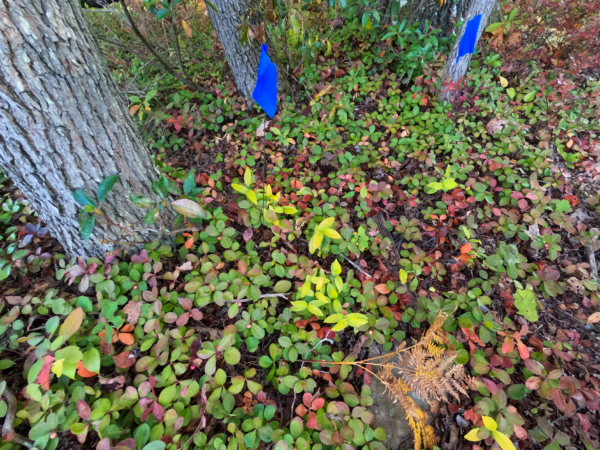
During the botanical survey in August 2025, CEC documented approximately 2,344 mountain bellwort individuals within the project area. Due to potential impacts from project activities, the PA-DCNR requested that each potentially impacted individual be relocated, which included approximately 1,115 mountain bellwort individuals.
Kyle created a relocation plan that was designed to protect and support the existing individuals while simultaneously allowing for project activities to remain on schedule. The relocation plan was reviewed and approved by the PA-DCNR and then implemented in September 2025.
In addition to Kyle, CEC’s botanists and ecologists team comprised of Travis Ciotti, Trevor Conlow, Shawn French, Kathleen Grkman, Christopher Imbrogno, Josh Paradise, Jackie Rockey, Ellie Ruffing, and Jeni Spang successfully relocated all 1,115 mountain bellwort by adapting best relocation practice methods to encourage successful survivability. These best practice methods included:
- Mountain bellwort individuals within the limits of disturbance were identified and demarcated with pin flags.
- Spade shovels were used to excavate mountain bellwort individuals or clumps. The excavation hole was dug approximately 6 to 8 inches horizontally from the center of each plant to preserve the lateral fibrous roots. Additionally, each hole was dug approximately 4 to 6-inches vertically to preserve the lateral root system and rhizome. Due to the composition of the herbaceous stratum, associated species including Gaultheria procumbens and Sitlobolium punctilobulum were typically relocated with each mountain bellwort individual or clump.
- The excavated mountain bellwort plants were staged in the back of a pickup truck and then transported to each relocation plot.
- At each plot, spade shovels were used to excavate an area to accommodate each mountain bellwort individual or clump. Once planted in each hole, the mountain bellwort individual or clump was packed into place using access soil or duff excavated from the relocation area.
- Each relocated mountain bellwort individual or clump was watered for approximately 10 seconds to reduce transplant shock.
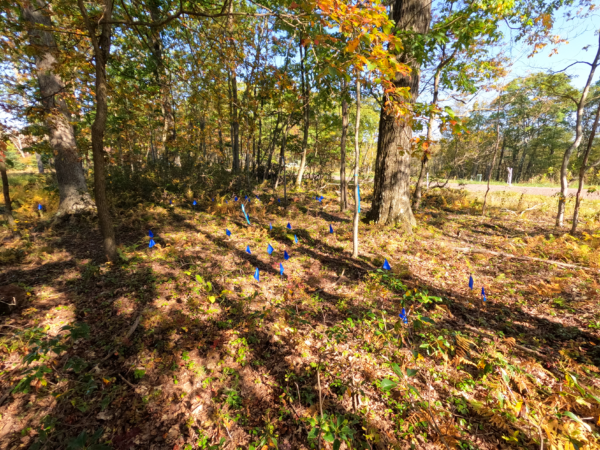
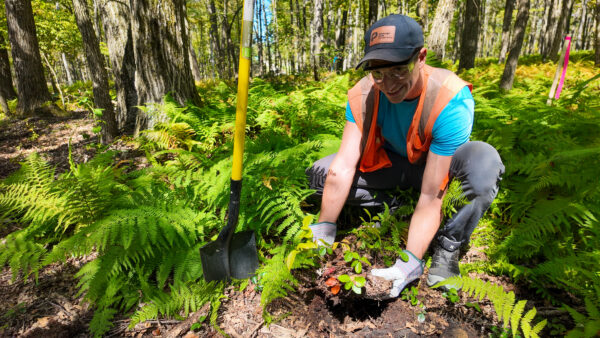
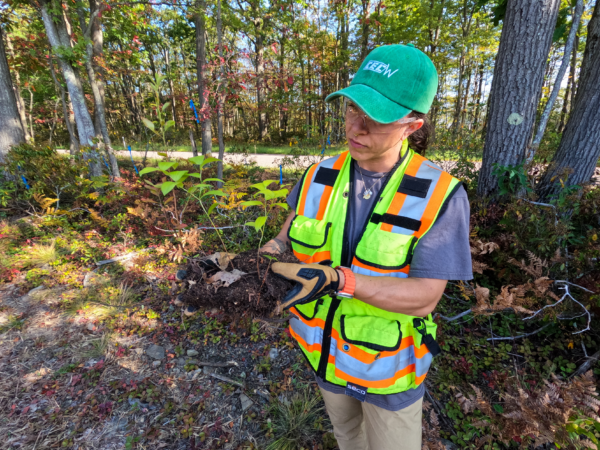
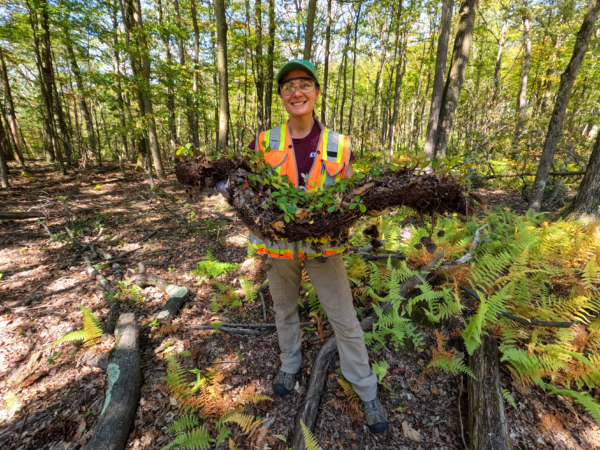
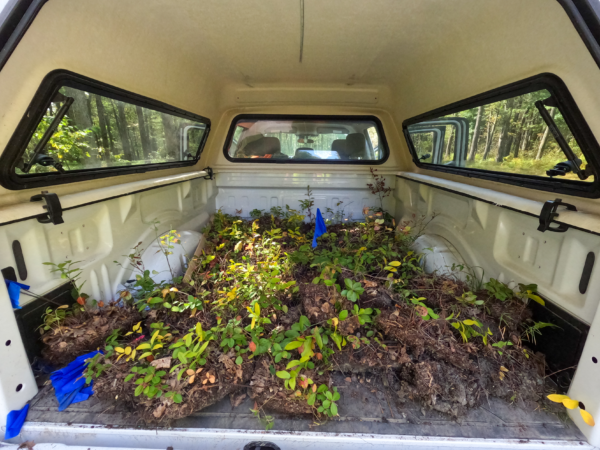

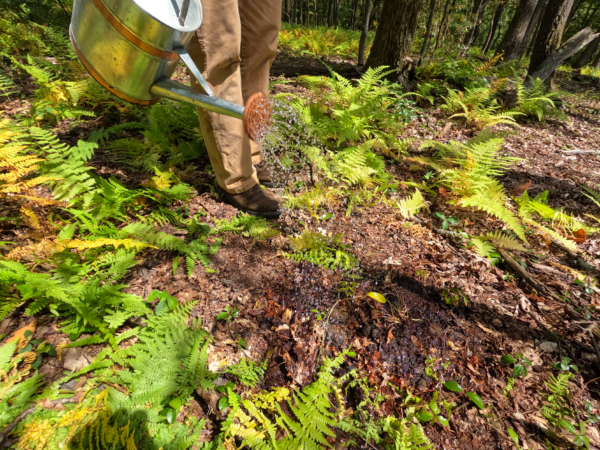
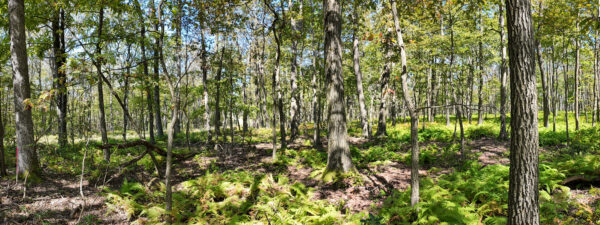
The relocation sites were chosen based on their soil composition, light regime, and associated characteristic species found within their original population. CEC botanists selected 10 relocation plots, comprised of three habitat types that support mountain bellwort.
During the mountain bellwort relocation, CEC and PA-DCNR botanists determined it was best to relocate the 30 St. Andrew’s cross individuals when this species is dormant in the late winter/early spring of 2026. In the meantime, CEC demarcated the population with orange construction fence.
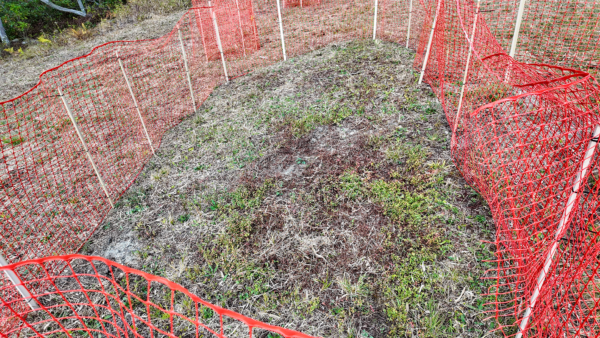
In February 2026, CEC botanist Alex Casile, along with Kyle and Travis, relocated 36 St. Andrew’s cross individuals to three relocation plots. As outlined in the approved relocation plan, CEC implemented the following best practice methods to successfully relocate each individual or clump:
- Snow shovels were utilized to clear approximately 6 to 8 inches of accumulated snow coverage. Remaining snow coverage was carefully removed by hand to expose St. Andrew’s cross individuals.
- Spade shovels were used to excavate St. Andrews cross individuals or clumps. Due to the growth form of St. Andrews cross, excavation holes were dug approximately 12 to 16 inches horizontally from a centroid point, within each large (5-foot by 5-foot) plant clump. If an individual was small (2-foot x 2-foot), excavation holes were dug approximately 4 to 6 inches from the center of the plant. Additionally, each hole was dug approximately 4 to 6 inches vertically to preserve the lateral root system and rhizomes.
- The excavated St Andrews cross individuals were staged in the back of a pickup truck and then transported to each relocation plot.
- At each plot, spade shovels were used to excavate an area to accommodate each St Andrews cross individual or clump.
- Once planted in each hole, the St. Andrews cross individual or clump was packed into place using access soil.
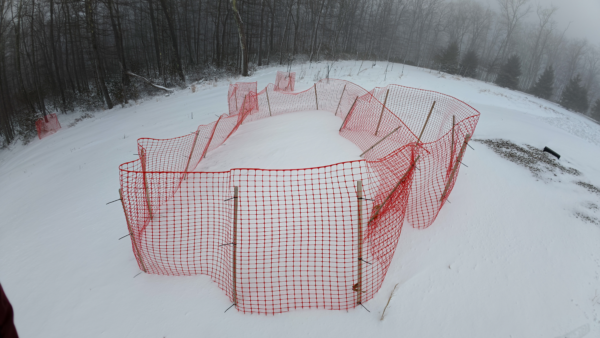
St. Andrew’s cross individuals and clumps covered in 6 to 8-inches of accumulated snow. 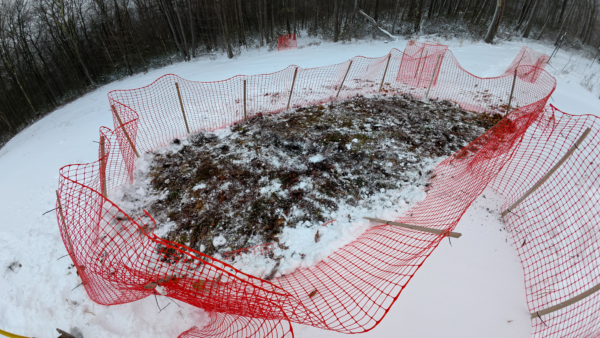
Snow coverage removed to expose the St. Andrew’s cross individuals. 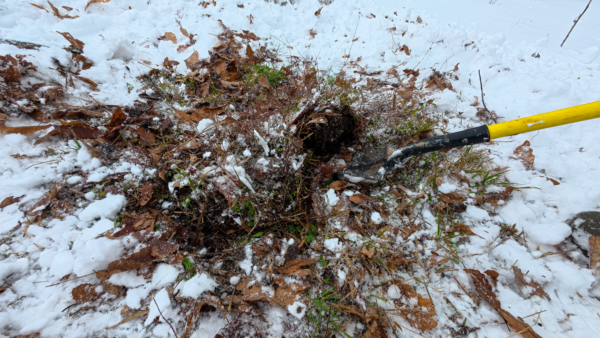
Excavating a St. Andrew’s cross clump. 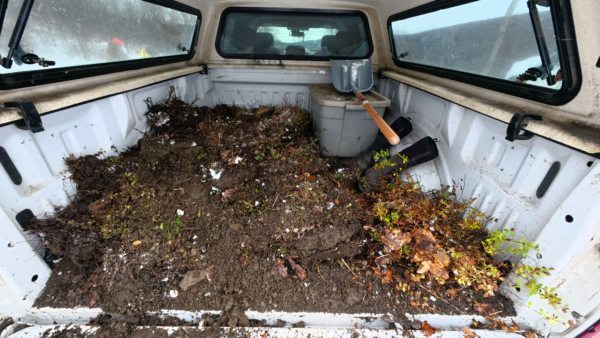
St. Andrew’s cross staged into the back of the truck for transportation to the relocation plots. 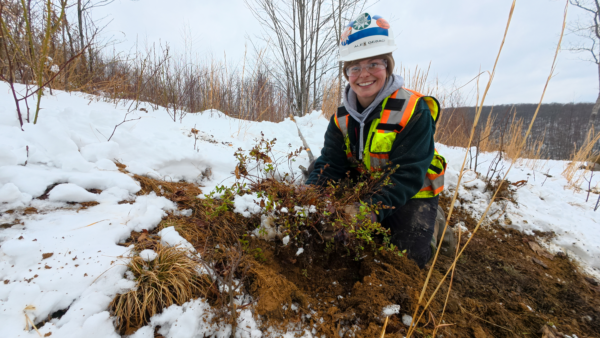
Botanist Alex Casile planting an excavated St. Andrew’s cross within a relocation plot. 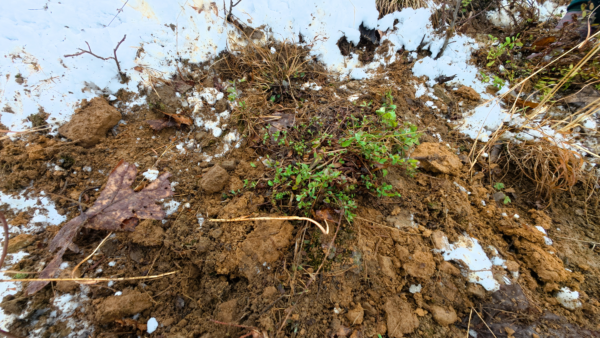
A relocated St. Andrew’s cross planted within the relocation plot.
Continuous Monitoring
The project permittee and CEC botanists will continue to monitor both the Uvularia puberula and Hypericum stragulum for five years, through 2030. During the monitoring, the project permittee and CEC will monitor the survival rates, reproductive success, and overall long-term population growth for both relocated species. Potential factors that could contribute to the use of additional adaptative management strategies include deer herbivory, invasive competition, or environmental stress.
This is the Way
During each botanical survey, relocation, and monitoring effort, CEC botanists review each project thoroughly and coordinate with each appropriate stakeholder, the project applicant and the state or federal review agency. By carefully planning and executing, project timelines remain on schedule while simultaneously rare, threatened, and endangered species are successfully identified and/relocated to be conserved for future generations.

Post a Comment