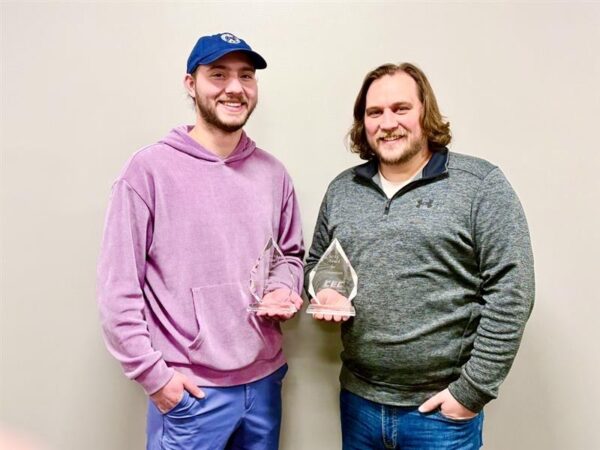
Brad Nagy, Project Consultant, and Zach Metzler, E.I.T., Project Manager, have been awarded a 2025 CEC Innovation Award for their work developing and advancing remote monitoring systems slope stability monitoring.
Their innovative approach enhances safety, improves decision-making, and delivers long-term cost savings for waste management and mining clients alike. They both work in CEC’s Monroeville office’s Waste Management practice.
Nagy and Metzler are also co-authors of an article appearing in the February 2025 issue of Waste Advantage magazine, titled Management of Slope Stability Risks Using Geotechnical Instrumentation. The article highlights how remote geotechnical instrumentation can transform how sites monitor slope behavior and manage risk.
Improving Safety and Decision-Making Through Real-Time Data
Geotechnical instruments play a vital role in monitoring the long-term stability of critical slopes at landfills or mining sites. By leveraging remote monitoring technology, engineers gain access to real-time data, allowing them to identify trends, detect anomalies, and proactively address potential issues before they escalate into costly or dangerous failures.
Data collected from these remote devices enables CEC engineers and clients to detect and respond to changes in slope behavior early, improving both site safety and operational efficiency. The monitoring system removes delays associated with traditional site visits and manual data interpretation, providing continuous visibility into slope conditions.
A Modern Approach to Monitoring Landfill Slopes
The system developed by Nagy and Metzler integrates a suite of sensors and devices that allow both CEC and clients to monitor the physical properties and behavior of the waste mass. These instruments include:
- Piezometers and vibrating wire piezometers
- Stability Monitoring Points (SMPs)
- Global Positioning System (GPS) units
- Settlement plates
- Inclinometers and tiltmeters
- Thermistors
All devices can be configured for cloud-based data collection, storage, and interpretation, enabling stakeholders to access information anytime and anywhere.
Beneficial in Both Data Collection and Cost Savings
Traditional monitoring methods are labor-intensive and often result in infrequent data collection. Observations can also be subjective, varying from one inspector to another. In contrast, remote monitoring delivers consistent, objective, and continuous data.
Nagy explains that movement thresholds are established for each type of instrumentation, triggering automated alerts when concerning conditions are detected—without the need for immediate engineering review.
“The traditional method of data collection is extremely labor-intensive,” Nagy says. “Now we have a constant data stream every hour, on the hour, with automated alerts notifying us immediately if something exceeds established thresholds.”
While the upfront cost of installing remote monitoring instruments may be higher than traditional methods, significant cost savings are realized over the life of the project. Reduced site visits, less manual labor, and early detection of issues all contribute to lower long-term expenses.
Enhancing Site Safety
The safety benefits of remote monitoring are substantial. By reducing the need for personnel to access potentially unstable slopes, the system significantly reduces exposure to hazardous conditions.
“The old way of collecting data put people in danger, especially in areas with unstable slopes,” Metzler says. “These automated systems allow us to keep people safe while still obtaining better-quality information.”
Traditional Monitoring vs. Remote Monitoring
Traditional Slope Monitoring
- Labor-intensive, leading to infrequent data collection
- Personnel exposed to hazardous conditions
- Delays in data interpretation
- Delays in communicating observations
Remote Monitoring
- Higher initial cost, but more economical long term
- Keeps personnel out of dangerous areas
- Provides a constant, real-time stream of data
- Automated alerts communicate concerns immediately
What the Instruments Measure
Each instrument provides critical insight into landfill behavior:
- Piezometers measure subsurface pore pressures in the slope.
- SMPs, GPS sensors, and settlement plates track horizontal and vertical movement over time.
- Inclinometers monitor slope angle and detect ground movement.
- Tiltmeters measure subtle shifts near excavations or known areas of concern.
- Thermistors monitor subsurface temperatures at sites with elevated temperature concerns.
Remote sensing data can also be integrated with ground-based instruments to identify areas susceptible to slope stability issues and detect long-term trends and patterns.
2025 Innovation Award by Jonna Miller




Post a Comment