

The Tennessee Department of Environment and Conservation (TDEC) has developed the state’s first‑ever Tennessee Volunteer Emission Reduction Strategy (TVERS) Comprehensive Plan. Through funding by a U.S. Environmental Protection Agency Climate Pollution Reduction Grant, Tennessee joined with 44 other states, over 200 tribal nations, 80 metropolitan statistical areas and other organizations to develop ambitious climate action plans aimed at reducing greenhouse gas emissions across the country.
CEC’s technical expertise shaped nearly every core component of the strategy. Leading the charge was Kris Macoskey, a vice president in Pittsburgh’s Air Quality practice, and Jenny Rickford O’Brien, a project manager in Knoxville’s Environmental Engineering and Sciences practice.
Created Tennessee’s First Statewide GHG Emission Estimates
CEC was responsible for transforming existing data and community feedback into a clear, science‑based roadmap to guide voluntary emissions reduction across the state for decades. Our work included:
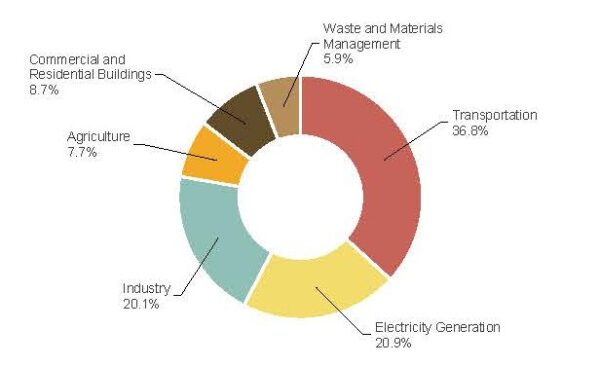
- Construction of Tennessee’s first complete multi-sector picture of annual greenhouse gas emissions. The work culminated with identifying transportation, electricity generation, and industry as the largest source categories, while highlighting the important carbon‑storage role of Tennessee’s forests and natural lands.
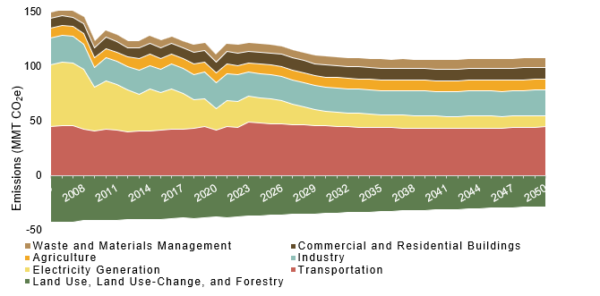
- Creation of long‑range “Business‑As‑Usual” projections through 2050 showing what emissions might look like if the state took no actions to reduce greenhouse gas emissions. That analysis became the baseline for exploring multiple greenhouse gas emission reduction options.
 Evaluated GHG Reductions
Based on TDEC’s synthesis of community input and the state’s priorities, CEC developed and applied methodologies to estimate and forecast the impacts of a collection of 26 voluntary strategies to reduce greenhouse gas emissions across all sectors of the Tennessee economy, such as:
- electric vehicle adoption (transportation sector),
- increased solar and nuclear energy (electricity generation sector),
- improved agricultural practices (agriculture sector),
- energy efficiency in industry, homes, and businesses (industrial and buildings sectors),
- food‑waste diversion (waste sector), and
- expanding and conserving Tennessee’s forests and grasslands (land use sector).
Our modeling quantified how each measure could reduce greenhouse gases, improve air quality, strengthen community resilience, and support economic and workforce opportunities.
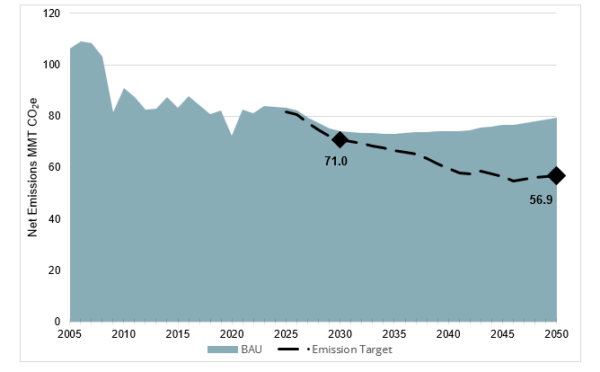
Helped Set Tennessee’s 2030 and 2050 Emissions‑Reduction Targets
CEC’s analysis supported the creation of Tennessee’s first statewide GHG reduction goals based on sector-specific targets that are data‑driven, achievable, and tailored to the state’s unique energy landscape and voluntary approach.
CEC evaluated how each strategy could improve air quality, reduce energy costs, support local jobs, and strengthen resilience so the plan benefits Tennesseans in every corner of the state.
Achieved a Collaborative Milestone for Tennessee
CEC worked closely with TDEC, state agencies, local governments, utilities, nonprofits, academic partners, and members of the public throughout the development process. Our team effort ensured that the final plan is:
- rigorous and science‑based,
- aligned with Tennessee’s economic strengths,
- voluntary and incentive‑focused, and
- designed to improve quality of life for all Tennesseans.
This landmark collaboration marks a major step forward for the state. It’s one that strengthens Tennessee’s leadership in clean energy, supports workforce growth, protects natural resources, and helps maintain the high quality of life Tennesseans enjoy today.




Post a Comment